
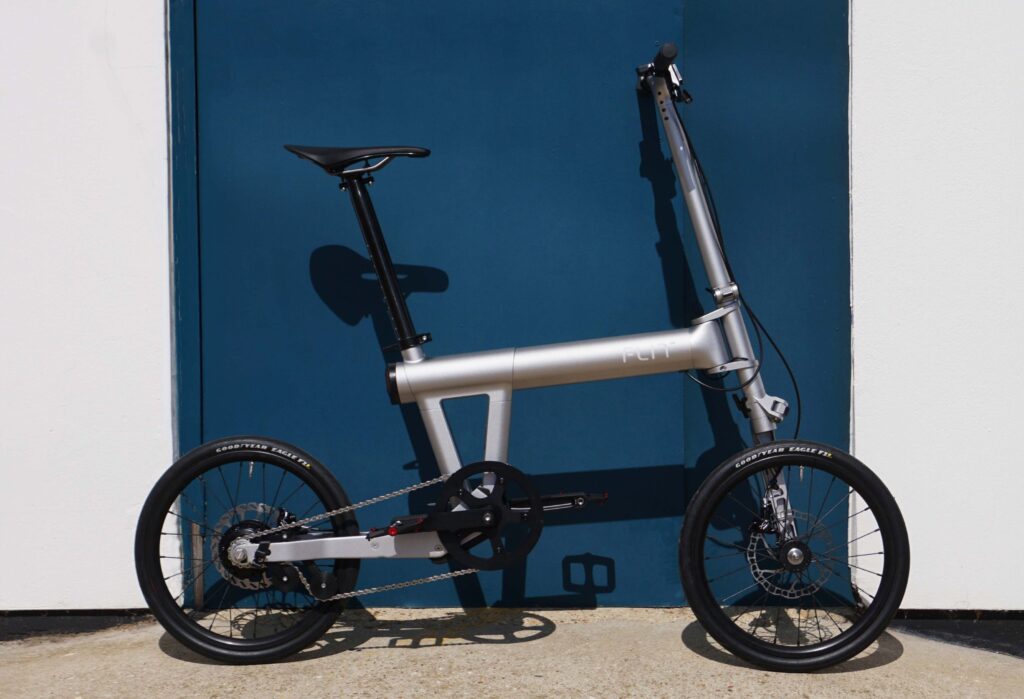
the FLIT M2i: the lightest premium folding ebike you can buy | 13.3kg
You should ask three questions when looking for the lightest premium folding ebike:
Does it easily fold small?
Is it a pleasure to ride?
Can you actually carry it?
With the FLIT M2, customers have long told us that it does the first two well, but the weight? Well, nobody will complain if you make a bike lighter.
You feel the weight every time you climb the steps to your flat or lift it onto a train. That is where the grams count, and it is where most riders quietly curse under their breath if they feel like they’re lugging a lump of metal around.
Now, the M2 was already pretty light for a folding ebike: sub-15kg is nothing to be sniffed at and not many bikes that ride well sit in that group.
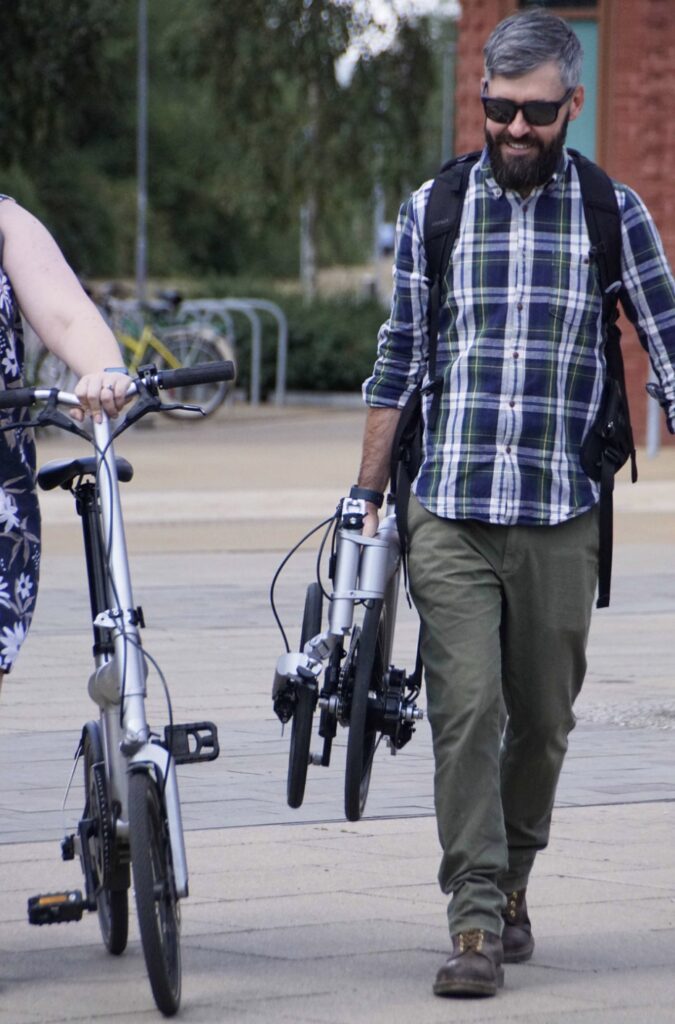
But we knew that we could go lighter.
So the FLIT team set themselves a challenge that sounds simple and is anything but: take the M2 and go even lighter, chasing the very best-in-class, gram by gram. No gimmicks, no asterisks, no ‘weight excludes battery’ fine print. Just engineering obsession and an unreasonable attention to detail.
The result is a groundbreaking bike with a market-leading weight: the FLIT M2i, 13.3kg including its in-frame battery. As far as we can tell, that makes it the lightest premium fully folding ebike you can buy.
And here’s the thing: it is lighter than the all-titanium Brompton Electric T Line, at nearly half the price. More on that comparison in Part 2 of this blog post.
Caveat: you can make a very light bike by making a very bad bike
There are a couple of caveats above: “premium” and “fully folding”. We chose these deliberately. If you want to cut corners to save weight on a folding ebike, you can easily do so.
The simplest approach is to make the bike poorly, using flimsy hinges and parts that cut the headline weight, but that do not stand up to the daily grind of a big city commute. We’ve all seen these bikes. They are essentially disposable. Ride one for a year, and then when something breaks and no mechanic will touch it, get a new bike.
The other cheeky thing that you can do is to make a ‘folding bike’ that doesn’t fold much. If you pop the handlebars down and maybe swing the rear wheel under, you will have a smaller bike, but it won’t go in the luggage rack and your fellow commuters on a packed 07:28 train won’t thank you for it.
At FLIT, we only make useful, robust, and serviceable ebikes. It doesn’t always grab the headlines, but it leaves us satisfied with a job well done. It also means that a good chunk of FLIT riders upgrade whenever we launch a new bike, so we think we’re doing something right.

Born in Cambridge, refined by obsessives
The M2i is not a new bike so much as the logical conclusion of an existing one.
We designed, tested, and hand-build the FLIT M2 in Cambridge. It has a patented folding aluminium frame and an in-frame battery that were unusual from the start.
To make the M2 lighter still, FLIT went shopping among the best component makers in the business and specified the bike the way a weight-conscious rider would specify their own. The partners we chose tell you everything about the intent:
- Hope Technology supplies the XCR Pro X2 hydraulic disc brakes. Precision-machined brakes from Britain’s most respected component manufacturer, front and rear. Entirely made in Barnoldswick, Lancashire.
- Goodyear provides the Eagle F1 R, its flagship bicycle tyre, in the M2i’s 16″ size. Low weight, low rolling resistance, proper handling from a famous automotive brand acting as an insurgent in the bike business.
- fizik of Italy’s Vento Antares R3 saddle. Genuinely light, designed for all-day riding, and a standard fitting so you can swap it if you prefer your own.
We applied the same strict criteria to the rest of the components:
- RideNow TPU inner tubes (the TPU revolution finally arrives on small wheels)
- KMC X9SL hollow-pin chain from the Taiwanese masters
- Union Jack POM Ultralight pedals with titanium spindles
- AMS Extralight grips designed to handle the roughest Spanish terrain
- Ashima AiRotor front disc




Taken together, the upgraded components are worth around £875 over the standard M2 and cut weight without compromising the ride.
The result: 13.3kg, battery included.
Why the in-frame battery matters
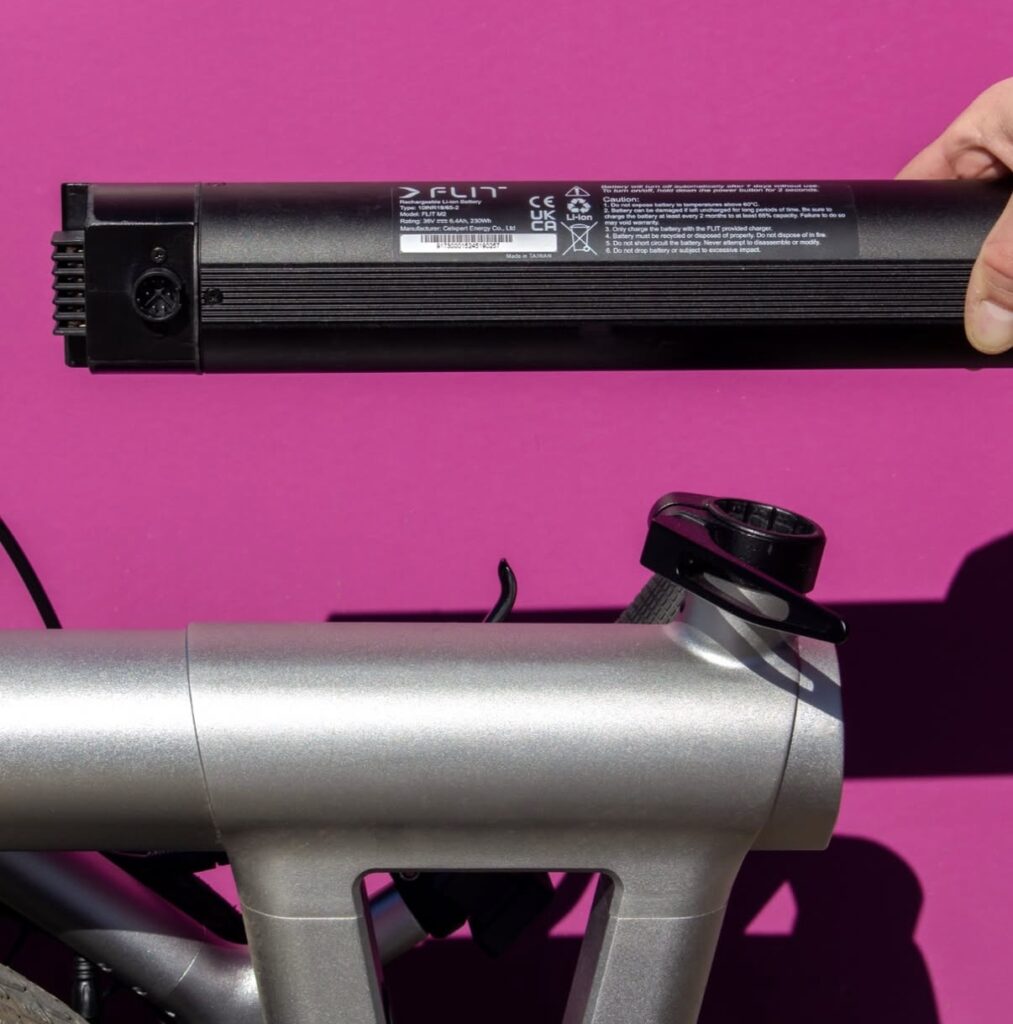
Most folding ebikes treat the battery as an afterthought: clipping it to a rack, strapping it to the frame, or stuffing it into a front bag. The M2i’s 230Wh lithium-ion battery (LG cells) lives inside the frame. That does three things.
First, it keeps the stated weight honest: 13.3kg is the bike as you carry it, power and all.
Second, it keeps the fold clean. There’s nothing to detach, nothing to carry separately, no bag occupying the space where your actual luggage should go.
Third, it centralises the mass, which is why the M2i feels well-balanced to ride.
The battery remains removable, so you can charge it on or off the bike. It charges from empty to full in around 3 hours and has a range of up to 50km depending on loaded weight, assist level, and terrain.
The practical details
The M2i folds to 797mm × 600mm × 305mm in seconds, rolls when folded, and unfolds just as quickly.
The drive is single speed (44T × 12T), the right call for a light urban bike, with the torque sensor and motor combination doing the work gears otherwise would.
Mudguards (£60, +450g) and a kickstand (£15, +180g) are optional, so you choose whether your bike stays at its fighting weight or gains all-weather practicality.
The price is £2,999. We make each bike by hand in Cambridge in limited batches and allocate them to customers on a first-come, first-served basis.
Is it the lightest premium folding ebike in the world? We think so. We have checked the competing claims carefully, and once you include everything a rival bike needs to ride a realistic commute (a decent-sized battery, pedals, the lot) we have yet to find a production premium folding ebike that beats it.
Other folding ebikes have been suggested to us such as the Dahon K-Feather, the Prodrive Electric Folding Bike, or the Lemmo Zero. We argue that these either have significantly lower performance components, don’t fold much, or skimp on things like realistically usable battery range to achieve headline weights that do not reflect how people actually ride the bike.
What we can say with certainty, from the manufacturers’ own published figures, is that it is 500g lighter than the lightest ebike Brompton has ever made, a bike built from titanium that costs from £5,799.
That comparison deserves proper scrutiny, so we break it down in Part 2 of this blog post.
